
Where Science Meets the Wild: Why Camp Ondessonk Is the STEAM Summer Camp Your Teenager Has Been Waiting For
By Camp Ondessonk Communications Team
How 983 Acres of Southern Illinois Wilderness Turn Curious Teenagers into Confident, Career-Ready Leaders
Picture this: your teenager is kneeling at the edge of a creek in the Shawnee National Forest, field notebook open, sketching the structure of a rockwork creek crossing they just helped to build to protect a restored riverbank. They’ve spent the day working alongside their crew and a volunteer coordinator with the Shawnee National Forest to rebuild a section of eroded trail, hauling rock, shaping drainage, and reading the land. They’re not watching a video about restoration conservation; they’re doing restoration conservation. They’re not sitting through a lecture on ecosystems; they’re restoring one with their own hands. And tonight, they’ll celebrate that work around a campfire with s’mores and a newly formed community that may become lifelong friends.
This is Camp Ondessonk, and this is what STEAM (Science, Technology, Engineering, Art, and Mathematics) education looks like when it leaves the classroom and finds its natural home in the woods.
As parents of teenagers, you’re navigating a challenging question every spring: How do I find a summer experience that actually matters? One that keeps my kid engaged, builds real skills, and isn’t just another screen-based distraction? The research is clear: nature-based learning programs produce measurable gains in confidence, teamwork, and problem-solving that exceed those of traditional classroom instruction alone (Annie E. Casey Foundation, 2023; Children & Nature Network, 2024). Camp Ondessonk’s two newest teen programs, Eco Adventure and Art & Earth Adventure, are built on exactly that research, and they deliver results parents can see on the first day their teenager walks back through the door.
Why Camp Ondessonk Is Different: 60+ Years of Excellence Meets 21st-Century Learning
Camp Ondessonk isn’t a new experiment. Nestled in the forested hills of southern Illinois near Ozark, the Camp has been shaping young lives for more than six decades. It is accredited by the American Camp Association (ACA), a gold standard that guarantees rigorous safety protocols, qualified staff, and programming grounded in best practices for youth development. It’s 983 acres of hardwood forests, sandstone bluffs, and creek corridors, which serve as a living laboratory that most school districts could only dream of.
For Summer 2026, Camp Ondessonk has unveiled two landmark programs specifically designed for teens ages 13–15 who are hungry for more than a conventional camp experience. These programs don’t treat STEM and the Arts as separate disciplines they weave them together the way the real world does, because engineers need creativity, scientists need communication skills, and artists need to understand the ecosystems they’re drawing from.
Eco Adventure: Real Environmental Science, Real Adrenaline
Ages 13–15 | Beginner Level | Campwide Frontcountry Adventure
If your teenager lights up when talking about climate, wildlife, or sustainability, or if they’ve ever expressed interest in environmental science, civil engineering, or ecological research, Eco Adventure was designed with them in mind.
This isn’t a nature walk with a worksheet attached. In Eco Adventure, campers become genuine stewards of Camp Ondessonk’s forests and the surrounding Shawnee National Forest. Under the guidance of trained staff and land management personnel, they take on active ecological restoration projects: restoring historic sandstone glade and savannah ecosystems, mitigating invasive species, monitoring forest health metrics, and implementing sustainable trail engineering techniques. Every single one of these activities is authentic STEAM in action.
The STEAM Breakdown in Eco Adventure:
Science: Campers unveil drivers of soil composition and erosion, identify native versus invasive plant species, observe forest succession cycles, and collect field data on ecosystem health, using the same methodologies as professional ecologists.
Technology: Teens use field notebooks, hand levels, and analog surveying tools to assess trail conditions, record data, and map the land around them, building the same observational discipline used by professional field scientists and land managers.
Engineering: Campers apply principles of sustainable trail design, calculate load-bearing requirements, manage water runoff, and construct erosion-control features using natural materials.
Art: Campers experiment with their own personal design aesthetic as they select rocks from the nearby environment to design and construct hardened creek crossings that both protect the vulnerable creek environment while also blending in with the natural surrounds and providing trail users with a visually appealing trail experience.
Mathematics: Whether computing slope percentages, measuring invasive species spread, or crunching data from their field surveys, participants engage in applied math with immediate, visible consequences.
And then, because the best learning happens when challenge and reward intersect, Eco Adventure balances this restoration work with pure outdoor adventure. Teens tackle top-rope rock climbing on Camp Ondessonk’s iconic sandstone bluffs or mountain biking on our purpose-built forest trails. These activities aren’t just fun; they’re calibrated risk experiences that teach self-regulation, courage, and group problem-solving under pressure. Research from the Children & Nature Network confirms that backcountry adventures support not just physical development but also psychological resilience, social-emotional growth, and long-term mental health (Children & Nature Network, 2024).
By the end of the session, your teenager won’t just know what a riparian buffer is, they’ll have built one.
Art & Earth Adventure: Where STEAM Meets the Southern Illinois Forest
Ages 13–15 | Beginner Level | Campwide Frontcountry Adventure
There’s a persistent myth in education that science and art belong in separate buildings. Camp Ondessonk’s Art & Earth Adventure program dismantles that myth completely and does it with remarkable elegance.
In this program, the Shawnee National Forest becomes a studio, a lab, and a library simultaneously. Campers gather natural materials such as clay, bark, native plant pigments, and wild grasses and then learn the ancient and contemporary practices of ancestral and regional artisan crafts. They carve wood, weave reed baskets, create hand-bound nature journals, and experiment with natural dye processes. But here’s what separates this from a typical arts and crafts session: every creative decision is rooted in expressive ecological and cultural inquiry.
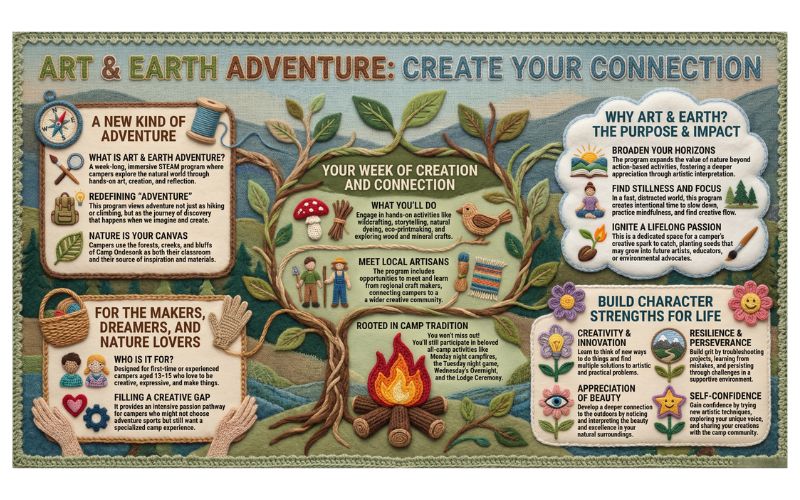
The STEAM Integration in Art & Earth:
Science meets Art: When campers extract pigment from native plants to dye fabric or paint natural canvas, they’re conducting a chemistry experiment. When they identify which species produce which colors and why, they’re learning plant biology and ecology.
Engineering meets Design: Crafting a structurally sound basket requires the same analytical thinking as any engineering problem, understanding material properties, testing structural integrity, and iterating on design.
Technology meets Communication: Campers record their observations, processes, and reflections in nature journals, practicing scientific documentation alongside expressive writing and illustration.
Mathematics meets Visual Art: Symmetry, proportion, and pattern, foundational mathematical concepts, are explored through the lens of natural design. From the fractal patterns of fern leaves to the geometry of bark textures, campers draw inspiration from nature to create their own interpretive expressions of beauty and function.
Camp Ondessonk understands Art & Earth Adventure as an immersive program that inspires teens to express themselves creatively through nature, using multiple nature-based media to interpret their discoveries (Camp Ondessonk, 2025). What this can look like in practice is a teenager who spends a morning identifying plants with a field guide, spends an afternoon pressing and illustrating them in a journal, and spends an evening presenting their findings to the group around the fire, building science literacy, artistic skill, and public speaking confidence in a single day.
For parents raising creative kids who also want them to develop scientific literacy, Art & Earth Adventure is the opportunity you’ve been looking for.
Adventure Skills Are STEAM Skills: The Learning Your Teen Won’t Find in a Textbook
One of the most powerful and frequently overlooked aspects of Outdoor Camp programming is how naturally outdoor adventure skills map onto STEAM competencies. At Camp Ondessonk, this isn’t incidental. It’s intentional.
Tying a load-bearing anchor knot? That’s a hands-on lesson in physics, specifically the application of tension, friction, and mechanical advantage. Reading a topographic map? Spatial mathematics and geometric reasoning. Understanding why a fire needs oxygen, fuel, and heat? Basic chemistry and thermodynamics. Reflecting on a day’s lived experiences with one’s community of fellow campers around a fire? That’s verbal artistic expression, an oral tradition that humans have engaged in for millennia. These aren’t metaphors for STEAM, they are STEAM, delivered through experience in a context that makes learning unforgettable.
A 2025 study published in the Journal of Pedagogical Research found that week-long STEM-focused outdoor camps produced statistically significant increases in participants’ interest in STEM careers and their applied understanding of scientific and mathematical concepts (Amanova et al., 2025). This matters for parents planning their teenager’s future: one summer at Camp Ondessonk may do more to solidify your child’s interest in science, technology, art, or environmental careers than an entire semester of classroom instruction.
And the learning isn’t passive. Every tool, every technique, every challenge in these programs is hands-on, participant-led, and consequence-based, meaning teens experience the immediate results of their decisions. That’s a pedagogical model that classroom environments structurally struggle to replicate.
Beyond STEAM: The Leadership Development Every Parent Is Looking For
The skills that get teenagers into top universities and successful careers aren’t just technical; they’re interpersonal, executive, and emotional. And this is where Camp Ondessonk’s philosophy goes beyond the acronym.
The American Camp Association has documented extensively that quality camp experiences develop independence, character, empathy, collaborative problem-solving, and self-confidence at rates that traditional educational environments simply can’t match (American Camp Association, 2018). In both Eco Adventure and Art & Earth Adventure, these outcomes are baked into the daily structure, not added as an afterthought.
Here’s what that looks like in practice: A camper who arrives nervous about hiking difficult terrain is, by midweek, coordinating gear logistics for their trail crew. A teenager who’s never spoken in front of a group is, by the final evening, presenting their nature journal to a campfire audience with visible pride. A kid who’s never thought of themselves as a scientist is suddenly teaching a younger camper how to identify invasive species. These moments aren’t manufactured; they emerge naturally when the environment is designed correctly.
Camp Ondessonk structures each program day around goal-setting, active problem-solving, and guided reflection, the three-part cycle that research consistently identifies as the core mechanism of transformative youth development (Garst et al., 2025). Teens don’t just do things at Camp; they understand what they did, why it mattered, and what they’re capable of next.
What Parents Most Often Ask Us – and Our Answers
“Is this a real educational experience or just recreation?”
It’s both, and that’s precisely the point. The research is clear that experiential, nature-based learning produces measurably greater gains than passive classroom instruction for many skillsets, particularly in science, critical thinking, and leadership. Your teenager will return home with documented skills, a nature journal or craft portfolio, and the kind of applied knowledge that shows up in college applications and job interviews.
“Is my teen too old for Camp?”
Absolutely not. This is a common misconception worth addressing directly. The American Camp Association’s own research identifies the teen years as one of the highest-value windows for camp programming, precisely because adolescents are developmentally primed to take on responsibility, refine their identity, and push their own limits in a supportive environment. These programs are specifically designed for ages 13–15.
“Is it safe?”
Camp Ondessonk is ACA-accredited, meaning it has met or exceeded the American Camp Association’s standards across more than 300 health, safety, and program quality criteria. Rock climbing, mountain biking, and trail work are conducted under the supervision of certified staff, with appropriate safety equipment and progressive skill-building protocols.
Give Your Teenager a Summer That Changes How They See the World
Today, our teenagers are growing up in a world that will need environmental scientists, sustainable engineers, ecological designers, and creative problem-solvers more urgently than any generation before them. The question isn’t whether your teenager needs these skills, but how and where will they learn them.
Camp Ondessonk’s Eco Adventure and Art & Earth Adventure programs offer something rare: a summer experience that is simultaneously adventurous, intellectually rigorous, emotionally formative, and genuinely fun. Campers don’t just learn about the natural world; they become active participants in it. They don’t just study STEAM, they practice it with muddy hands and wide-open eyes. And at the end of every long, purposeful day, they celebrate the way generations of Camp kids have: with marshmallows, stories, and the kind of laughter that comes from having earned your rest.
Camp Ondessonk has been transforming young people in the Shawnee National Forest for more than 60 years. These new programs represent the next chapter of that tradition, and your teenager’s chapter starts this summer.
Registration for Summer 2026 is now open. Learn more and secure your teen’s spot.
References
American Camp Association. (2018). Rethinking Summer: Why Camp Remains Relevant for Teens. Camping Magazine. American Camp Association. https://www.acacamps.org/article/camping-magazine/rethinking-summer-why-camp-remains-relevant-teens
Amanova, C., Wright, P., and Brynteson, K. (2025). From Camps to Careers: Analyzing the Impact of Summer STEM Camps on Students’ Career Choices. Journal of Pedagogical Research. https://www.ijopr.com/download/from-camps-to-careers-analyzing-the-impact-of-summer-stem-camps-on-students-career-choices-17306.pdf
Annie E. Casey Foundation. (2023). Building Skills Outdoors: How Nature-Based Programs Strengthen Youth Development. https://www.aecf.org/blog/building-skills-outdoors-how-nature-based-programs-strengthen-youth-development
Camp Ondessonk. (2025). Discover the Future of Teen Adventure: Camp Ondessonk Unveils Exciting New Programs for Summer 2026. https://ondessonk.com/discover-the-future-of-teen-adventure-camp-ondessonk-unveils-exciting-new-programs-for-summer-2026-2/
Children & Nature Network. (2024). Research Digest: Backcountry and Wilderness Adventures. https://www.childrenandnature.org/resources/research-digest-backcountry-and-wilderness-adventures/
Garst, B., Vanic, M., Melton, T., Foster, C., and Bowers, E. (2025). Principles and Practices of Impactful Nature-Based Positive Youth Development Programs. Current Opinion in Psychology. https://www.sciencedirect.com/science/article/pii/S2352250X25000612