What’s with all the trees cut down around Camp?

A Different Kind of Care for a Place We Love
If you’ve walked the trail to Cedar Falls or hiked near the units of Goupil and Chabanel recently, you might have been surprised to see areas where trees have been cut down. For a place so deeply committed to its natural environment, seeing felled trees at Camp can be jarring. But this activity isn’t about harm; it’s a thoughtful and necessary act of care. At Camp Ondessonk, we believe that many interconnected parts are essential for the health of the whole. This applies to our camper cabins, our staff teams, and especially our forest. This “connections-based approach to land management” means we look at our forest as a complete ecosystem and make decisions to keep the entire system thriving for generations to come. What makes this work so valuable here is that Camp Ondessonk’s forests are special. Because our history has focused on recreation and connection, rather than timber production, our forests retain a remarkably intact natural heritage, especially the wildflowers and plants on the forest floor. Professional foresters recognize this unique health, noting that our land offers a “greater return on conservation investment.” The work you’re seeing is a crucial part of honoring and protecting that legacy.
A Forest in Transition
To understand why this work is so important, let’s look at the superstar of our forest: the oak tree. For centuries, our hills have been dominated by magnificent oak and hickory forests, but that is slowly changing.

A Shift to the Shade
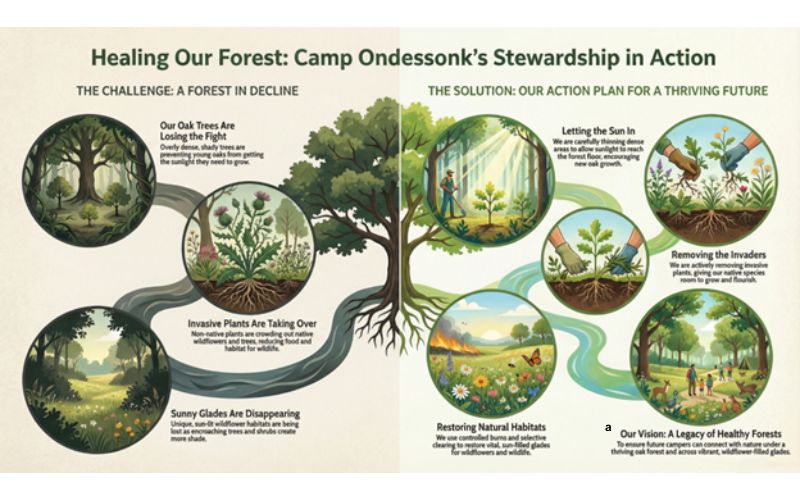
The central challenge facing our oaks is a process called Mesophication. This is an ecological term for a gradual shift from the sunny, open oak-hickory forests of the past to darker, shadier forests dominated by species like sugar maple and beech. The problem is simple: oaks are sun-dependent. Their seedlings and saplings need significant sunlight to reach the forest canopy. Without it, they get crowded out by shade-loving trees that thrive in the dark understory you might see when you walk through many parts of Camp Ondessonk. The result? As our older oaks die, there is no new generation ready to take their place.
The Missing Ingredient: Disturbance
Historically, natural disturbances like fire would sweep through the landscape, clearing the understory and creating sunny gaps in the canopy. These events were key in allowing young oaks to flourish. Without regular disturbances, the shade-tolerant trees have grown unchecked, creating a dense, dark mid-story that spells trouble for the future of our oak forests. This shift has created a problem that won’t fix itself, which is why we’ve decided to step in.

Our Solution: “Intentional Disturbance” to Let the Light In
The tree cutting you see is a form of intentional disturbance, a science-based strategy to mimic nature’s healing processes and give our forests the fighting chance they need. “This is not destruction; it is strategic, responsible forestry aimed at ecological regeneration.” Our work has two primary goals. The first is to regenerate our oak forests. The second is to restore another unique and threatened habitat here at Camp: our sandstone glades and barrens. These are the beautiful, sun-drenched, rocky openings you find along the bluff tops in areas like the Pakentuck area, the Chabanel barrens, and popular overnight spots like “Wayne’s World,” “Vega’s Vista,” and “Pepsissehwa.” These special habitats are also being choked out by trees like winged elm and eastern redcedar, and we will work to open them back up to the sky, as well.
How It Works: Forest Stand Improvement (FSI)
To achieve these goals, the primary tool we’re using is called Forest Stand Improvement (FSI). Think of it like tending a garden. To get healthy, strong tomato plants, you have to pull the weeds that steal sunlight and nutrients. Forest Stand Improvement is the same idea, just on a much larger scale. Our “weeds” are the fast-growing, shade-tolerant trees like sugar maple, beech, and elm that have sprung up and are now crowding out our oaks and glades. Trained professionals identify and thin out these specific competitors to reduce competition and allow the strongest, healthiest oaks and hickories to thrive.
Fighting the Invaders
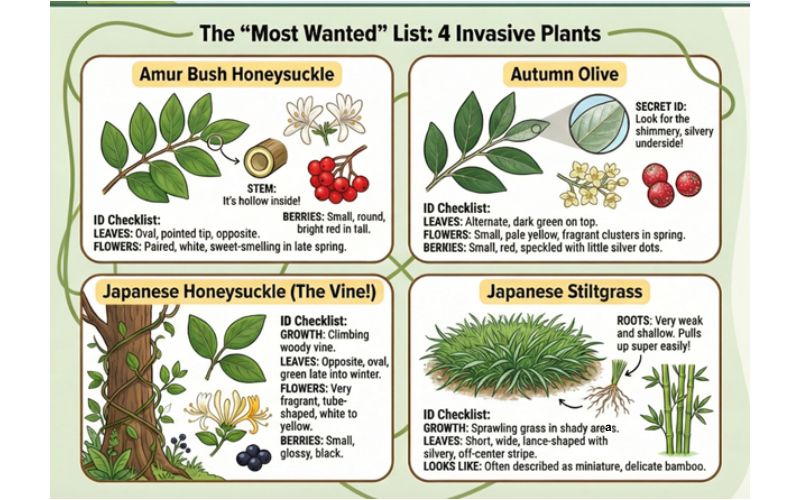
A second, equally important ‘battle’ we’re fighting is against the non-native invasive plants that threaten our forest’s health. These aggressive plants can quickly take over, choking out the native species that our wildlife depend on. These deliberate actions are not random; they are part of a carefully designed, long-term strategy for the future of Camp’s forests.
A Plan for a Healthier Future
All of this work is guided by Camp Ondessonk’s 10-year Forest Management Plan. This comprehensive strategy was developed in close partnership with expert foresters from the Illinois Department of Natural Resources (IDNR) and the Shawnee Resource Conservation & Development District (RC&D). This collaboration ensures that every action we take is based on sound science and proven conservation practices. Forest Stand Improvement is just one tool in our toolbox. In the coming years, we will also add another intentional land management method: prescribed fire. These low-heat fires mimic historical disturbances by clearing the leaf litter, which helps acorns reach the soil, while also controlling the saplings of competing shade-loving species.
Our Commitment
The changes you see in the forest today are a visible sign of Camp Ondessonk’s deep and lasting investment in the health of this land. We are acting as stewards, working to reverse a decades-long decline and restore the strength and resilience of our forest ecosystems. Our goal is to ensure that for generations to come, campers will continue to forge connections with the natural world beneath the branches of a healthy, thriving oak forest and across the sun-lit, wildflower-filled glades that make this place so special.